12 Old-Fashioned Games Children Actually Played (And How to Run Them at Your Harvest Party)
Old-Fashioned Games that should never go out of style.
When we finished our Pioneer Adventure classes, I asked our students what their favorite part had been.
Their answer surprised me.
It wasn’t the candle dipping, fire starting, or sewing their own bags. It was the old-fashioned games we taught them!
In fact, Button, Button, Who’s Got the Button? and Kick the Can were two of their favorites. I found that rather interesting. Here we were teaching children all these wonderful old-fashioned skills, and some of their favorite memories came from playing games that required almost nothing.
No screens. No elaborate toys. Just a few everyday objects and some friends to play with.
It reminded me that children really haven’t changed all that much. They still want to run around, laugh, compete, challenge themselves, and have fun.
Sometimes we just need to give them the opportunity.
Please read our Disclaimer and Terms & Conditions
What Did Children Actually Play in the Old Days?
Depending on the time period, culture, family circumstances, and available materials, children’s games looked a little different.
But one thing they had in common was making use of what they had.
Viking-Age Children’s Games and Toys
Viking children had toys made from materials such as wood, cloth, bone, and clay. Archaeological discoveries have revealed miniature boats, animal figurines, dolls, and other small toys.
Children also had wooden swords and other miniature weapons. Spinning tops and whistles were made from materials such as bone or wood.
And play wasn’t limited to toys!
Norse literature describes physical games such as knattleikr, a ball game involving sticks that is sometimes compared to modern hockey or lacrosse. Wrestling was also part of Norse physical culture.
Board games were popular throughout the Viking world. One of the most well-known was Hnefatafl, a strategy game involving a king, defenders, and attackers.
Hnefatafl happens to be one of our family’s favorite games to play!
While we have archaeological evidence of Viking toys and gaming pieces, the exact rules of some games have been lost. Many modern versions are based on historical reconstructions.
Colonial Children’s Games
Colonial children enjoyed games involving hoops, marbles, spinning tops, and simple household objects.
Some familiar games included:
- Tag and hide-and-seek.
- Hoop rolling and hoop races.
- Cup-and-ball.
- Whirligigs.
- Nine Men’s Morris.
Later generations also enjoyed games such as Graces, which became particularly popular during the early 1800s.
Many of these games required very few supplies, and children could often make their own equipment.
Pioneer Children’s Games
Pioneer children enjoyed many of the same traditional games passed down through earlier generations.
Games such as marbles, hoop rolling, Blind Man’s Buff, and Button, Button, Who’s Got the Button? were familiar forms of entertainment.
Kick the Can is another traditional American game that became one of our students’ favorites during our Pioneer Adventure!
Many of these games survived because they didn’t require expensive toys or special equipment.
Whether a family had very little or plenty, children could still find ways to play.
And that’s one of the things I love most about them.
When Toys Weren’t Something You Simply Bought
One of the things I find fascinating about children’s games throughout history is how often they made use of what they already had.
A discarded barrel hoop could become a racing toy. Scraps of cloth could become a doll. Stones could become playing pieces, and a simple piece of wood could be turned into a toy.
Not every child had the same opportunities or materials, of course. But children have always been wonderfully creative when given the chance.
And perhaps that’s something we could bring back today.
Instead of purchasing everything for our children, what if we helped them make some of their own toys?
A homemade game might not look as perfect as something purchased from the store, but there’s something special about playing with something you’ve made with your own hands.
12 Old-Fashioned Games to Bring Back
Here are twelve traditional games you can introduce to your children or include at your next harvest party.
Some have ancient origins, while others were especially popular during the Colonial and Pioneer periods.
You don’t need to recreate every historical detail perfectly. The goal is to introduce children to these wonderful old games and let them experience the fun for themselves!
1. Graces
Historical period: Especially popular during the early 19th century.
Supplies: Two pairs of wooden catching sticks and a lightweight hoop.
Graces is a simple game that takes a little practice to master. Two players stand facing each other. One player places the hoop over their two sticks and spreads the sticks apart, launching the hoop toward the other player.
The second player attempts to catch it on their own sticks.
It sounds simple, but getting that hoop to go where you want it can be quite the challenge!
Fun fact: Girls were only allowed to play this game, because it was believed to help develop gracefulness and coordination. A boy was only allowed to play if he was playing with another girl.
Harvest party idea: Create a Graces station and challenge children to see how many successful catches they can make.
2. Rolling the Hoop
Historical period: Colonial and Pioneer eras.
Supplies: A wooden or metal hoop and a guiding stick.
Children sometimes repurposed discarded barrel hoops or other suitable materials to make their toys. Hoops could also be handmade or purchased.
The goal is simple: keep the hoop rolling! Children run alongside their hoop, using a stick to guide it and keep it upright. It takes coordination, patience, and a little determination.
Harvest party idea: Set up a short course and challenge children to guide their hoop from start to finish without letting it fall.
You can even turn it into a friendly race!
3. Nine Men’s Morris
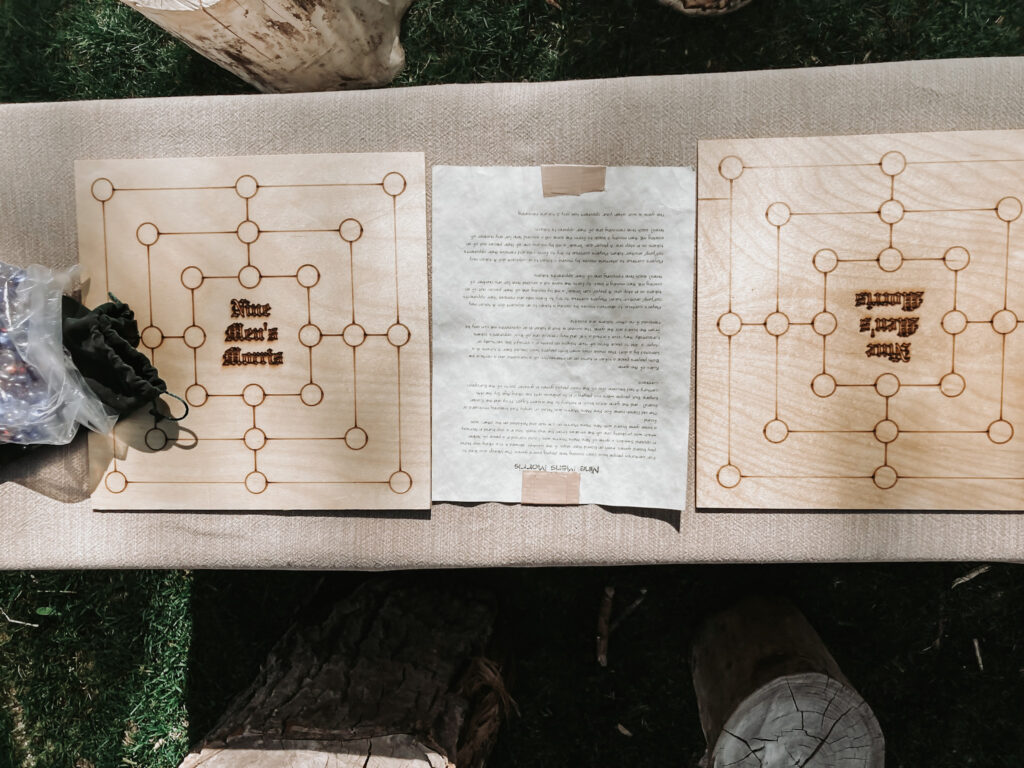
Historical period: An old European strategy game with roots reaching back well before the Colonial era.
Supplies: A game board and 18 stones or wooden playing pieces—nine for each player.
Nine Men’s Morris is a two-player strategy game.
Players take turns placing their pieces on the board, attempting to form rows of three, called mills.
When a player forms a mill, they can remove one of their opponent’s pieces.
Once all pieces have been placed, players move their pieces along the board’s lines, continuing to form mills.
The game ends when a player has only two pieces remaining or cannot make a legal move.
Harvest party idea: Draw a large board on a wooden tabletop or piece of canvas. Use dark and light stones as playing pieces.
This makes a wonderful quiet station for children who need a break from running around.
4. Knucklebones

Historical period: Ancient, with variations played across many cultures.
Supplies: Five cleaned sheep knucklebones or a modern set of jacks.
Knucklebones is an old game that challenges a player’s coordination and quick thinking.
Different versions have been played throughout history. In modern times we no longer use bones, but before our modern jacks small ankle bones were used due to how the edges would create the bones move around when tossing them.
For a simple version, try the following:
- Scatter five bones (or jacks) on the ground.
- Choose one bone to be your tossing piece.
- Toss it into the air.
- While it is airborne, pick up one bone from the ground.
- Catch the tossed bone with the same hand before it lands.
- Repeat until you have collected all the bones.
Once you’ve mastered picking up one at a time, try collecting two, three, or even four at once!
Harvest party idea: Create a knucklebones station and let children see how far they can get.
5. Blind Man’s Buff

Historical period: Played in Europe for centuries and familiar in Colonial and Pioneer America.
Supplies: A blindfold and an open playing area.
This game is sure to bring plenty of laughter!
One child is chosen to be the seeker and wears a blindfold. The other children move around the playing area while the seeker attempts to catch someone.
Once a player is caught, the seeker must guess who they have captured using their voice or other agreed-upon clues. If they guess correctly, the captured player becomes the new seeker. If they guess incorrectly, the player is released and the game continues.
Harvest party idea: Create a small playing area with soft ground and clear boundaries. Have an adult supervise, remove obstacles, and make sure children know not to push or trip the blindfolded player.
6. Drop the Handkerchief
Historical period: Traditional children’s game documented in the 19th century.
Supplies: One handkerchief.
This game is similar to duck, duck, goose, but instead you use a handerchief.
Children sit in a circle while one player walks around the outside carrying a handkerchief. Without being noticed, the player drops the handkerchief behind someone. When that child discovers it, they must grab the handkerchief and chase the first player around the circle.
The first player attempts to reach the empty spot before being caught. If successful, the second player becomes the new handkerchief carrier.
Harvest party idea: Use a simple linen handkerchief and play several rounds. This is an easy game for a larger group because everyone can participate.
7. Button, Button, Who’s Got the Button?
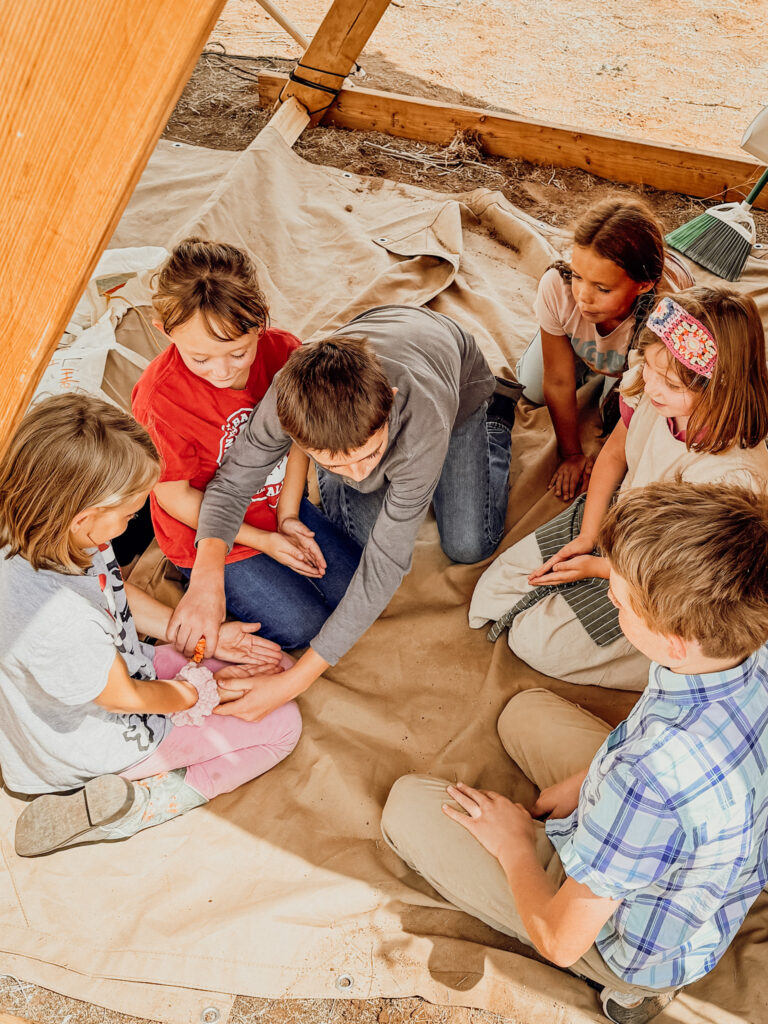
Historical period: Traditional American children’s game.
Supplies: One button.
This was one of our students’ favorite games during our Pioneer Adventure!
Children sit in a circle with their hands together, palms facing each other.
One child holds a button between their hands and moves around the circle, placing their hands between each player’s hands. At some point, they secretly drop the button into another child’s hands.
The trick is to make everyone think they might have received it!
Once the button has been passed, the child asks: “Button, button, who’s got the button?”
The other players take turns guessing who has it. If someone guesses correctly, they become the next person to distribute the button.
Harvest party idea: This is a wonderful quiet activity between more energetic games. For younger children, use a large wooden token instead of a small button.
8. Fox and Geese

Historical period: Traditional outdoor game.
Supplies: Snow or lines marked in dirt or grass.
Fox and Geese is often associated with winter play, but you can easily adapt it for an autumn harvest party.
Create a large circle with several paths leading toward the center, similar to the spokes of a wheel. Choose one child to be the fox. The remaining children are geese.
The fox attempts to catch the geese while everyone follows the marked paths. Players cannot leave the paths to escape! When a goose is caught, they become the new fox.
Harvest party idea: Mark your paths using flour, chalk, or rope. This is a great game for getting everyone moving!
9. Marbles
Historical period: Colonial and Pioneer eras.
Supplies: Clay or glass marbles and a circle marked in the dirt.
Marbles have been enjoyed for centuries, and handmade clay marbles were familiar toys in 19th-century America.
To play a simple version, draw a circle in the dirt and place several marbles inside. Each player takes turns using a larger shooter marble to knock the smaller marbles out of the circle.
The player who knocks the most marbles out wins!
Harvest party idea: Set up a small marble pit and let children try their hand at knocking marbles out of the circle.
10. Tug of War
Historical period: A traditional game with a long history across different cultures.
Supplies: A sturdy rope.
Sometimes the simplest games are the most entertaining!
Divide everyone into two teams. Mark a center line on the ground and place a marker in the middle of the rope.
Each team pulls, attempting to move the opposing team across the line.
Harvest party idea: End your games with a family tug-of-war challenge! Divide teams by age and size to keep things fair, and make sure everyone has a safe place to play.
11. Hnefatafl — The Viking Board Game
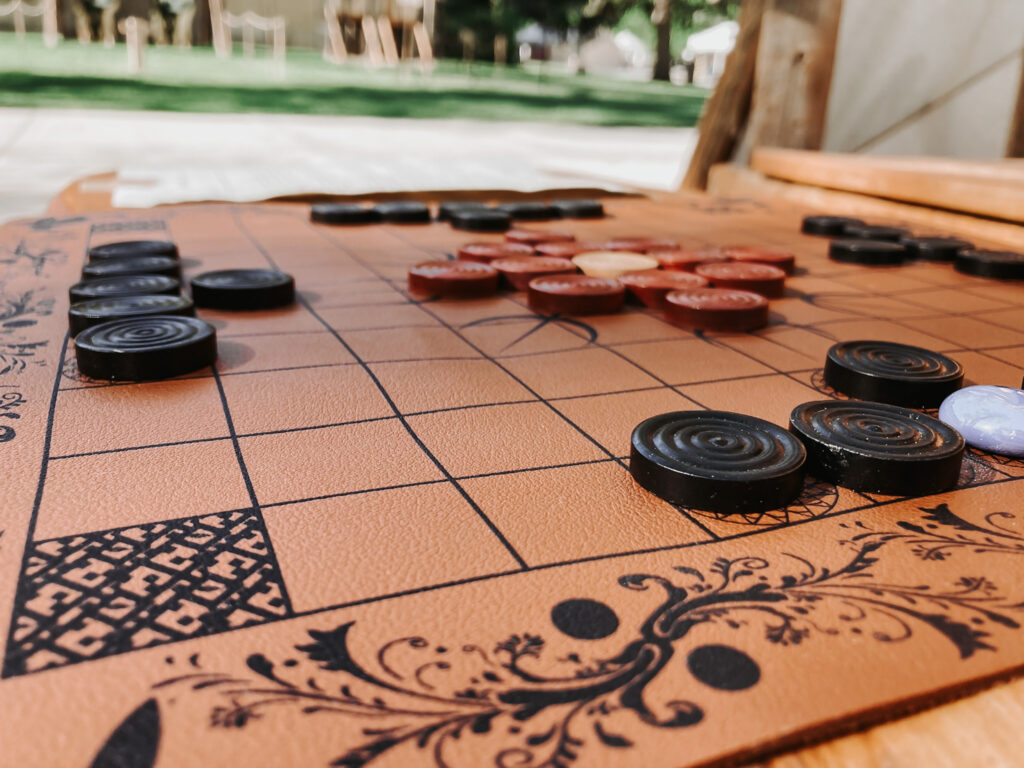
Historical period: Viking Age.
Supplies: A tafl board and two sets of playing pieces.
Hnefatafl is one of our family’s favorite games! I love watching our daughters brain think and plan her next steps. Even for myself it is a lot a strategy, but that’s what we love about it. It gets us thinking and planning in ways we are not use to.
Unlike many strategy games where both sides have the same objective, Hnefatafl gives each player a different goal.
One player controls the king and his defenders. The other controls the attacking force. The king’s goal is to escape, while the attackers attempt to capture him.
The exact rules used during the Viking Age have not been fully preserved, so modern versions use reconstructed rules.
Harvest party idea: Create a Viking game table where older children and parents can learn a simple version together. It’s a wonderful way to introduce strategy, planning, and a little Viking history!
12. Kick the Can
Historical period: Traditional American children’s game, particularly associated with later generations of outdoor play.
Supplies: An empty tin can or another safe object that can be kicked.
Kick the Can is a combination of hide-and-seek and tag.
And it was another favorite during our Pioneer Adventure!
To play:
- Place a can in an open area and choose one player to be “it.”
- The other children hide while the seeker counts.
- The seeker searches for the hidden players while keeping an eye on the can.
- When a hidden player is spotted, the seeker attempts to tag them before they reach the can.
- Tagged players go to a designated jail area.
- If a player manages to kick the can before being tagged, the captured players are freed!
The seeker wins by capturing all the players.
For our games, we also made sure the seeker couldn’t simply stand beside the can and guard it the entire time.
After all, where’s the fun in that?
Harvest party idea: Set up a designated playing area with plenty of hiding places. Use a lightweight can or soft object to avoid sharp edges or injuries.
How to Host an Old-Fashioned Harvest Party
You don’t need to spend a fortune or plan an elaborate event to give children a wonderful old-fashioned harvest party.
In fact, I think keeping things simple is part of the fun! Here are a few ideas to get started.
Step 1: Choose Four to Six Games
You don’t need to include all twelve games.
Choose a mixture of active games, quiet games, and activities children can enjoy independently.
For example, you could include hoop rolling, Graces, marbles, Button Button, Fox and Geese, and Kick the Can.
Step 2: Use What You Already Have
This doesn’t need to be expensive.
Look around your house, yard, or homestead for materials you can repurpose.
A few sticks, stones, pieces of rope, and household objects can provide hours of entertainment.
You might be surprised by how much you already have!
Step 3: Set Up Simple Game Stations
Set up different areas for each activity.
Children can rotate through the stations rather than waiting for everyone to finish one game before moving to the next.
You could even have older children help teach the games to younger ones.
Step 4: Include All Ages
Choose games that allow younger children to participate while giving older children opportunities to challenge themselves.
Some children may enjoy running and competing, while others prefer the strategy of a board game.
There’s room for everyone.
Step 5: Let the Children Play!
This might be the most important part.
Sometimes I think we believe we need to organize and schedule every second of an event. But what if we gave children a little breathing room? Let them create their own games, invent new rules, and figure things out together.
And when disagreements happen, don’t feel like you have to jump in immediately.
Of course, step in when someone is unsafe or needs help, but give children opportunities to work through smaller disagreements themselves. Learning to cooperate, compromise, and solve problems is part of play too!
Sometimes the best moments happen when we stop directing everything and simply let children be children.
A Simple Two-Hour Harvest Party Schedule
If you would like a little structure, here’s an easy schedule you can follow.
| Time | Activity |
|---|---|
| 15 minutes | Welcome and introduce the games |
| 45 minutes | Rotate through game stations |
| 20 minutes | Group games: Fox and Geese or Drop the Handkerchief |
| 15 minutes | Enjoy homemade harvest treats |
| 20 minutes | Family tug-of-war challenge |
| 5 minutes | Gather and share favorite games |
You could serve homemade bread, apple cider, cookies, or whatever seasonal treats your family enjoys.
And remember, this schedule is just a guide. If the children are having a wonderful time playing something, there’s no need to rush them along!
Why These Simple Old-Fashioned Games Still Matter
I sometimes think we believe that because something is old-fashioned, there must be a newer or better way. And as generations pass, we slowly begin to lose things.
Knowledge. Traditions. Skills. Memories.
So much of children’s lives today is structured and scheduled or indoors. I believe having time for freedom and play, especially outside is important.
These old-fashioned games give children that opportunity. They don’t require expensive equipment or elaborate preparation. No matter where you live, many can be played using everyday household items.
And while the children are busy having fun, they’re learning too! They’re developing coordination and physical confidence as they run, throw, catch, and balance. Getting exercise and spending time outside without even realizing they’re exercising. Children learning patience and perseverance when something doesn’t come easily. They are practicing taking turns, cooperating with others, and learning how to lose graciously. Children get to use their imaginations, thinking outside the box, and solving problems.
And perhaps most importantly, they’re building friendships and family memories.
These are the little things that matter. The things we often remember long after childhood has passed.
Bringing Back the Old Ways, One Game at a Time
You don’t need a large harvest party to bring these games back. Gather a few friends, invite the neighbors, or simply head outside with your children.
Teach them a few of these old-fashioned games, then give them some free time without screens or organized entertainment. Suggest a game you’ve taught them and see what happens. Watch as they make up new rules, challenge each other, and discover their own ways to have fun. You might just see a little of the old ways sparking excitement and creativity in your children.
And having grown up with a few of these games myself like button, button. It has been fun teaching the next generation these games. Remembering the same excitement and fun we had. And who knows? Maybe one day they’ll be teaching these same games to their own children, like I did.
Faith, Family, the Old Way.